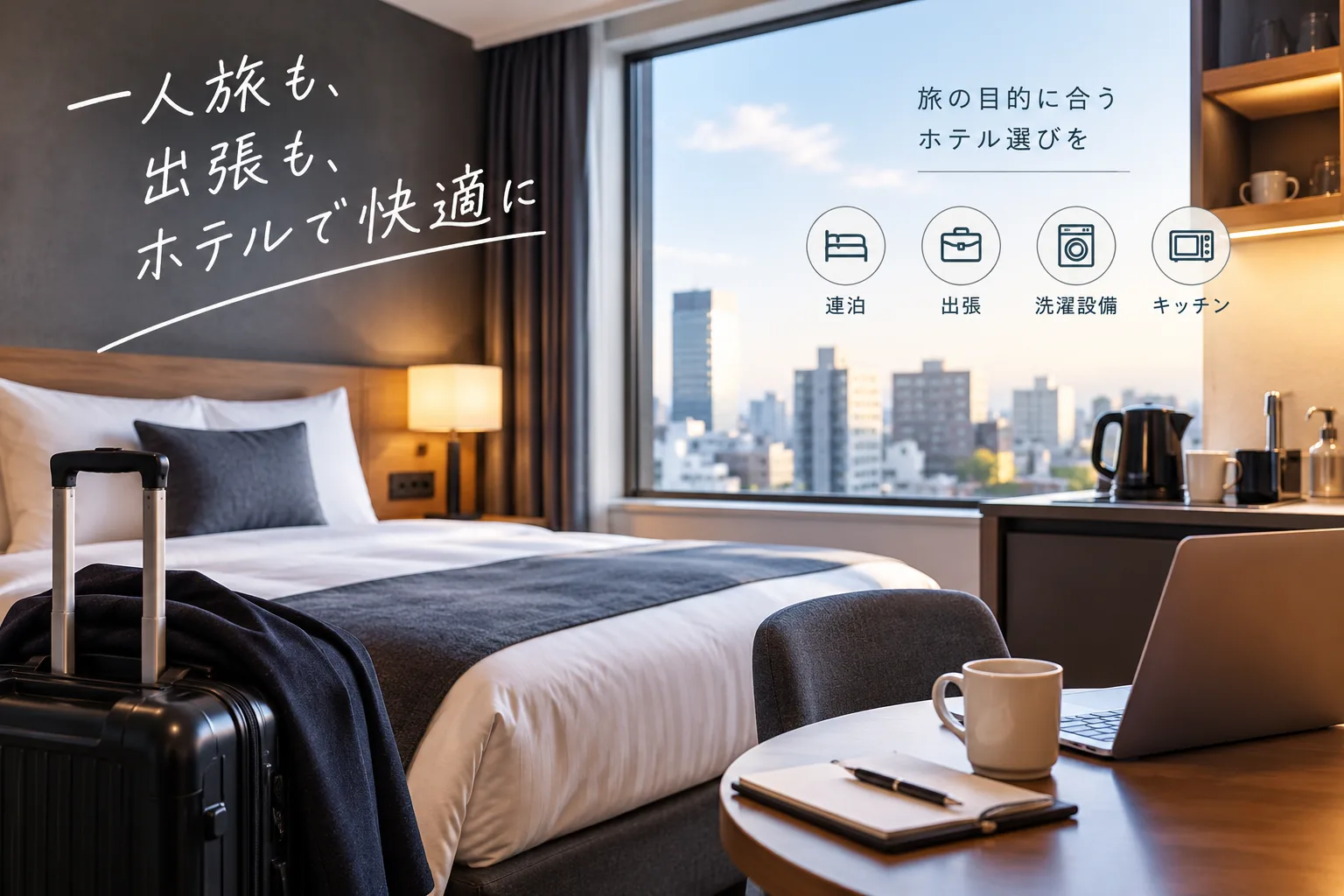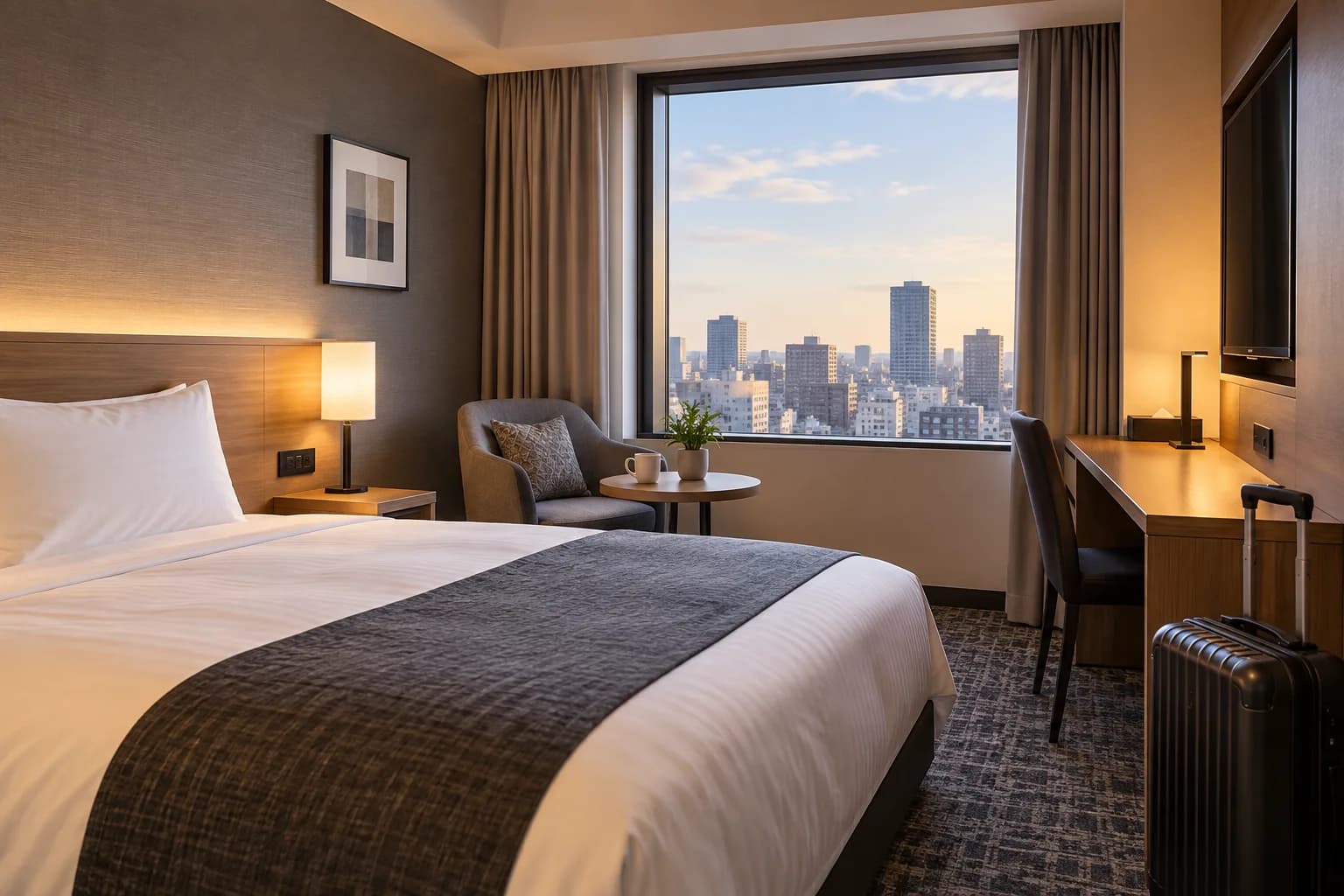
Can One Person Stay in a Semi-Double Room in Japan?
Learn whether one person can stay in a semi-double hotel room in Japan, how it differs from single and double rooms, and what to check on booking sites.
今回の更新内容
Expanded the semi-double solo stay guide with booking-site checks, price notes, FAQs and internal links.
Quick answer: yes, if the hotel offers the room for one guest
One person can stay in a semi-double room in Japan when the booking plan accepts one adult in one room. It can be a comfortable choice when you want more room to turn in bed or plan to spend a quiet evening in your hotel.
The word “semi-double” does not guarantee a spacious room. Some hotels place a wider bed in the same compact floor area used for a single room. Always check guest count, actual bed width, room area and luggage space together.
In short, it is fine when:
- the booking search is set to one adult and one room
- the plan can be booked for one guest
- the final price, cancellation rule and smoking/non-smoking status are clear
It is not unusual to use a semi-double bed alone in a Japanese business hotel.
What is a semi-double room?
A semi-double room normally has one bed and may be sold to either one or two guests. However, room labels and bed dimensions are not standardized across every Japanese hotel.
For example, APA Hotel specifications show a property where both single and semi-double rooms use a 1,200 mm-wide bed, while an official Toyoko Inn property document lists a 1,400 mm bed in one type of single room. The figures in the property’s booking details are therefore more useful than the room name alone.
Read “semi-double bed” and “semi-double room” separately
Booking pages may use several similar phrases:
- semi-double room
- room with a semi-double bed
- single room with a semi-double bed
- double bed for single use
The important checks are guest count, actual bed width and floor area. A single room with a semi-double bed can still be compact.
Single, semi-double and double compared
| Item | Single | Semi-double | Double |
|---|---|---|---|
| Common occupancy | One guest | One or two guests | One or two guests |
| Beds | One | One | One |
| Solo comfort | Basic | More turning room | More generous |
| Price tendency | Usually lower | Sometimes above single | Often higher |
| Main caution | Limited luggage space | Floor area may still be small | Not always sold for solo use |
Compare the final price and specifications for the same date. For a broader overview, see our guide to Japanese hotel room types.
Semi-double or single: which should you choose?
| Purpose | Easier choice |
|---|---|
| Lowest possible price | Single |
| More bed comfort | Semi-double for one |
| Large suitcase space | Larger single or twin for one |
| Desk work | Floor area and desk photos matter more |
| Longer stay | Semi-double or double for one |
A semi-double improves comfort on the bed, but it does not always improve floor space. If luggage space matters, prioritize square meters over bed width.
Benefits for a solo guest
More room to turn and rest
A wider bed can feel less restrictive, particularly for larger travelers, restless sleepers or business guests who want to feel rested the next morning.
Better for spending time in the room
It suits a quiet hotel evening with a book, a film or next-day planning. Bedside power outlets, lighting and a side table can matter as much as mattress width.
Good value when the upgrade is small
On some dates, the difference from a single room may be modest. If breakfast and other facilities are identical, compare the upgrade price with the extra comfort. The difference changes with demand and should not be treated as a fixed rate.
Does one guest pay for two?
Pricing varies by hotel. You may see:
- a semi-double plan specifically for one guest
- a room that accepts one or two guests with different prices
- room-based pricing where one and two guests are similar
- dates where semi-double rooms are not sold for one guest
Do not assume you will pay half of a two-person price. Search with one adult selected and compare the final total for single, semi-double and double rooms.
Drawbacks and easy-to-miss details
A wider bed can leave less floor space
A large bed in a compact room may narrow the walkway and leave nowhere to open a suitcase. Travelers with substantial luggage should prioritize floor area or under-bed storage.
The room may be priced per room
A solo guest does not necessarily pay half of the two-person rate. Search specifically for one adult and compare the final total, including taxes and service charges.
A “single room” may already have a wide bed
Some hotels describe the accommodation as a single room but install a semi-double or double-size bed. Conversely, a semi-double label may not match the width you expect. Read the numerical specifications.
Six checks before booking
- The search is set to one adult and one room
- The room has one bed and states its actual width
- Floor area is shown in square meters
- Smoking or non-smoking status is correct
- Bathroom, window, desk and luggage arrangements suit you
- The final total and cancellation deadline are acceptable
Do not assume that a two-person semi-double plan can simply be changed to one guest. If solo occupancy is unavailable, ask the hotel or select an official one-person plan.
How to check booking sites
On Japanese booking sites, start with the guest count.
- Set the search to one adult.
- Set the room count to one room.
- Compare single, semi-double and double rooms for the same date.
- Open the plan detail and check bed width, room area and smoking status.
- Compare the final price under the same meal and cancellation conditions.
Search result lists can be too brief. Always open the plan detail before booking.
Mistakes to avoid
- Assuming a two-person plan can be used by one guest
- Assuming the room is spacious just because it says semi-double
- Missing smoking/non-smoking status
- Checking bed width but ignoring room area
- Forgetting the cancellation deadline
Who should choose one?
- Travelers who find a narrow single bed restrictive
- Larger guests or people who move frequently in their sleep
- Guests planning to relax in the room after work or sightseeing
- Travelers who find a small price difference from a single
A single remains practical when you will only sleep in the room and price is the priority. If opening a large suitcase matters more than bed width, a larger single or a twin room for one may work better.
Related guides
- Can One Person Stay in a Double Room in Japan?
- Japanese hotel room types for solo travelers
- Solo hotel booking checklist
- Beginner guide to choosing solo accommodation in Japan
Frequently asked questions
Is it acceptable to book a semi-double room for one person?
Yes, when the booking page offers a plan for one adult. The number of people who check in must match the reservation.
Is it embarrassing to stay in a semi-double room alone?
No. Hotels care about whether your reservation matches the number of guests and the plan conditions. Solo use of a semi-double or double room is common enough in business hotels.
Is a semi-double too large for one guest?
It still has only one bed, so it does not create the unused-bed issue of a twin room. It is useful for relaxing, although a single may be better value for a sleep-only stay.
Is every Japanese semi-double bed 120 cm wide?
No. Dimensions and naming vary by hotel. Confirm the width in the room specification instead of relying on the label.
Do amenities change between one- and two-person use?
The room is normally the same, but towels, amenities and included breakfast are prepared for the number of booked guests.
Semi-double or double: which is better for a solo stay?
A double room can be more comfortable if the price difference is small and the room area is sufficient. Semi-double rooms are often easier to book at a moderate price, so compare final price and room size.
Is a semi-double safe for a solo female traveler?
The room type itself is not the key safety factor. Check the route from the station, lighting at night, front-desk hours, reviews and whether the hotel has women-only floors or women-friendly plans.
This article reflects general information as of September 21, 2026. Confirm current room names, dimensions, prices and occupancy rules with the hotel or booking page.